






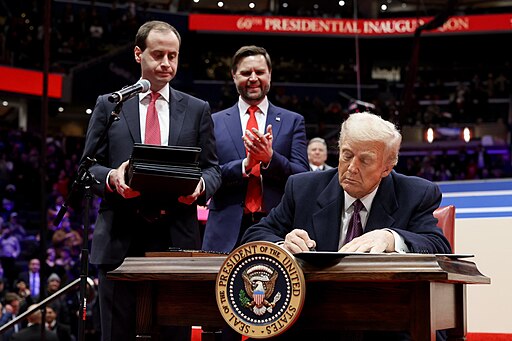
In his (second) first 100 days in office in 2025, President Donald J. Trump signed a record 143 executive orders, along with numerous presidential memoranda, proclamations, and other types of directives. Since then the president has continued to issue executive actions at a rapid pace – for instance, telling the secretary of education to shut down her department, doubling tariffs on imported steel and aluminum, barring new foreign students from attending Harvard University, sending National Guard troops to help with immigration enforcement in Los Angeles, imposing an expanded version of his first-term travel ban… and the list goes on.
So we thought it would be “good to know” what presidential directives are, generally, and what they can and can’t do.
What is a presidential executive order?
An executive order (EO) is a formal presidential directive to one or many people in the executive branch, shaping their behavior. As political scientist Phillip Cooper writes, these directives may require agency officers “to take an action, stop a certain type of activity, alter policy, change management practices, or accept a delegation of authority under which they will be responsible for the implementation of law.”
In short, an EO is a mechanism for exercising the “executive power” vested in the president by the U.S. Constitution. So any such directive must be consistent with authority granted to the president either by the Constitution itself, or by a law passed by Congress delegating that authority. Normally, executive orders are seen as vehicles for the “faithful execution” of the law the Constitution requires of the president. An EO may represent an interpretation of the law – but does not replace the law. As Robert Levy of the Cato Institute puts it, EOs “are not intended as a way for the executive branch to bypass Congress.” It’s worth stressing that EOs directly govern the actions of federal employees – but only indirectly those of private citizens, albeit sometimes in important ways.
EOs are a necessary tool in an administrative state where much responsibility is delegated to the executive branch. But partly these directives are issued to symbolize that the president is acting – leading! – on an issue the public (or the president’s core supporters, or an interest group of note) care about.
How many EOs have there been?
As of July 20, 2025, six months into Trump’s second term, the comprehensive list of numbered U.S. executive orders stood at 14,317. But this is a pretty big undercount. The official tally of executive orders was not undertaken until 1907, when the State Department arbitrarily labeled an 1862 order by Abraham Lincoln as EO 1. There were many orders issued before 1862, and we know that even the 1862-1907 list is incomplete. Scholars think we’re likely missing good records for tens of thousands of EOs. We do know that every president from George Washington on in 1789 has issued executive directives – even William Henry Harrison, who died in 1841 after only a month in office. (In case it comes up on Jeopardy: Harrison only issued one directive, and it was a proclamation – on which, keep reading!)
Keep in mind that the simple issuance of an EO is not some kind of proxy for “power” more broadly. A president issuing ten EOs is not ten times more powerful than a president issuing just one: the importance of an EO depends on its substance. Some EOs have an immediate impact; some are effectively plans to make plans; some are never implemented at all and, indeed, may be intended only as political position-taking, where the issuance of the EO is the entire point. We know, too, that in the last 15 years the proportion of the text within executive orders that’s devoted to language with no legal effect – essentially, rhetoric that more closely resembles a press release – has increased dramatically.
While Trump’s second term in 2025 is an important exception, the number of EOs issued per year has actually decreased over time. The last time before 2025 that as many as 100 were issued in a single year was 1952. The 1940s and early 1950s saw a large but temporary explosion in the use of EOs because of the New Deal growth of the executive branch and then World War II. Further, matters that used to require EOs no longer do. Until the 1970s, for instance, the president had to issue an executive order to allow anyone in federal employment past the mandatory retirement age to keep working.
And sometimes other directives are used in place of EOs. Which answers another question….
Is an EO the only kind of presidential directive?
No. In fact there are many – according to the Congressional Research Service, more than 20 types exist. The two most common are proclamations (to the wider public) and presidential memoranda (to agencies or individual government officials).
U.S. presidents have issued nearly 11,000 numbered proclamations overall. But, much like EOs, this is certainly an undercount. The name describes the purpose: The president is “proclaiming” to the public some sort of event or state of the world. Very often these proclamations are symbolic: The week starting June 8, for instance, was proclaimed as “Flag Week,” which is part of “National Ocean Month,” which itself is distinct from “National Maritime Day” (May 25, if no one sent you a card.)
Presidents often use more substantive proclamations in trade or immigration policy, or for presidential pardons. In July 2025, Trump even used a series of proclamations to delay recent EPA regulations limiting pollution from coal-powered electrical plants and other sources.
What about presidential memoranda?
Presidential memoranda are harder to count, because they are not required to be public. But these are also what they sound like, with a “to” (perhaps a single agency head, perhaps all of them) and a “from” (the president), and a more-or-less formal text about a given topic. Executive orders, used properly, use the president’s own power to tell an agency to do something. Memoranda, by contrast, represent the president telling (sometimes, technically, asking) an agency to do something using the agency’s power, for instance to issue a regulation or to interpret a law in a particular way.
But it is not uncommon for this distinction to be ignored, and the Department of Justice’s Office of Legal Counsel has said there is no difference across directives in terms of their legal efficacy. If you’re sitting in the Oval Office (or anywhere else), it’s certainly more fun to “order” something than to “memo” it. And there’s plenty of confusion in the press, and even among presidents, over what type of directive has actually been issued. Many administrative actions are commonly called “executive orders” but were not. For instance, if you Google the Deferred Action for Childhood Arrivals program (DACA) you’ll likely see an “AI Summary” saying that DACA “was established through an executive order by President Barack Obama in 2012.” But there was no such EO. The memo implementing the program wasn’t even from the president himself: It came from the secretary of Homeland Security. (Students take note: Any AI “facts” are to real facts as the “concept of a plan” is to a real plan.)
Strategizing with directives
Sometimes presidents simply substitute one directive for another. Critics like Senator Ted Cruz (R-Texas) – one of many legislators who used to pretend to care about such things – often attacked Obama as an “imperial president” obsessed with unilateral power. The president’s defense was to say that he had issued fewer executive orders than his predecessors. This was true – but somewhat misleading, since Obama’s use of memoranda rose to offset the decline in EOs.
Sometimes, instead, directives are deployed in sequence. A president might proclaim a certain state of the world, and then issue executive orders designed to correct that situation. For example, John F. Kennedy issued a proclamation in September 1962 condemning the state of Mississippi’s obstruction of court rulings against racial segregation –and then issued an EO the same day authorizing the Department of Defense to act to enforce the law.
What an executive order can – and can’t – do.
Any presidential directive must use authority already existing in the Constitution or federal law. An EO must cite the authority that justifies its issuance. And an EO is supposed to receive substantive approval from the Office of Management and Budget, as well as legal approval from the Department of Justice, before being issued. And (with a few exceptions) the executive order must be printed in the Federal Register. The first to appear there, in March 1936, was EO 7316.
As stressed above, an EO does not change the law – but it can set the tone for how the executive branch interprets the law. It cannot define “biological truth,” for instance (biology tends to do that) – but it can guide how the executive branch defines gender. All this means that EOs, while they do not apply directly to people outside the federal government, can have important indirect effects. Very important, in some cases: The internment of Japanese Americans during World War II came from a 1942 executive order authorizing the U.S. Army to create military zones from which civilians could be excluded. (Note, though, that Congress, and later the Supreme Court, also backed up that EO.)
More commonly, if the president tells federal procurement officers that federal contracts can only go to companies meeting certain criteria – not discriminating on the basis of race (Kennedy, Johnson) or offering a certain minimum wage (Obama) or not adhering to any “DEI” guidelines (Trump) – that obviously has a big impact on private sector behavior, given the multibillion-dollar scope of federal contracting every year. Trump’s imposition of tariffs, on the basis of his declaration of multiple “national emergencies,” has raised costs for American businesses and ultimately their customers. (It is far from clear that using this mechanism to manipulate tariff rates is legal.)
It’s worth noting two areas where Trump has used EOs in new ways. One is to explicitly order agencies not to enforce the existing laws, which one would presume is the opposite of “faithful execution.” Such directives have claimed the president has the power to set aside the Federal Corrupt Practices Act, and the recent law banning Tik-Tok. Trump has also used EOs to declare numerous federal regulations invalid, even though regulations have the force of law until they are revised or revoked using a specific process itself set out by statute.
The second area is a set of what we might call “retribution” or “vengeance” orders. These are cases where the president has directed legal investigations or otherwise seeks to punish firms or even specific individuals that have done things he doesn’t like. These kinds of directives violate the post-Watergate norm that criminal prosecution is supposed to be conducted professionally, not politically. And, according to multiple courts, any such moves violate the First and Fifth Amendments as well.
Do EOs undermine the separation of powers?
The answer – as so often to any interesting question – is “it depends.” If EOs are simply and directly implementing laws passed by Congress – which is very common – then no. Congress has certainly delegated a lot of authority to the president over time. So rather than passing new laws, a president may seek new meaning in old laws, using EOs or other directives to impose that meaning on the executive branch.
Still, the president’s interpretation of the old law must be plausible. Separation of powers issues arise when presidents substitute unilateral power for something for which they have failed to get congressional approval. Parallel issues could arise with the vertical separation of powers, too – especially when the executive branch tries to use federal funding as a weapon to punish states that don’t agree with the president’s interpretation of federal law.
When EOs start to represent a systematic circumvention of the traditional legislative process, the answer lies in Congress doing its job. Congress can and should revisit and update the statute books on a regular basis, so that it hasn’t given the president power it doesn’t want the president to have. Congress has many avenues to try to enforce its will – starting with oversight hearings and holding up presidential appointees, through the use of its power of the purse, all the way up to impeachment and removal in exceptional cases. But in recent years, Congress has failed miserably to stand up for itself and its own power.
Here’s a clear example. Presidents have invoked purported “emergencies” to justify executive action or to unlock existing statutory powers that are only available in times of declared emergencies. The problem in law is that there doesn’t have to be an actual emergency for the president to declare one – the president just has to say there is. (And Trump has said so very frequently.)
Congress has failed to restructure the law to limit this problem. More broadly, when presidents refuse to act in good faith or to recognize the limits of their executive authority, the rest of the political system must step up to the plate.
Are executive orders permanent?
No. Congress can overturn an executive order; and the courts can rule that a given EO goes beyond a president’s statutory or constitutional authority. (Ordering something that contradicts the text of the Constitution seems like a good example.) Furthermore, presidents often overturn their predecessors’ executive action. Trump bragged about doing this not only to Biden’s orders but to those issued by an array of presidents going back at least to Lyndon Johnson in the 1960s. Biden, for his part, overturned lots of Trump’s orders. Trump, in his first term, overturned many of Obama’s EOs.
The lesson is that executive action is fragile – it can be overturned by legislation, by the courts, or by subsequent presidents. Free advice: If you want lasting change, enact a law! But to the degree that other political actors allow the president to do things that go against the letter of the law, the Constitutional balance – and U.S. democracy – suffers. The discussion in this post has presumed that executive branch policymaking still has an analogue to what legislative scholars call “regular order.” Trump’s second term has greatly strained that assumption.
Andrew Rudalevige is Thomas Brackett Reed Professor of Government at Bowdoin College and the author of By Executive Order: Bureaucratic Management and the Limits of Presidential Power (Princeton University Press, 2021). He thanks Kenneth R. Mayer for helpful feedback on this article.
Related Good Authority posts
- Andrew C. Rudalevige, “Trump’s executive orders: Everybody loves butter.” From January 2025, a tally of first-week executive orders, including President Trump’s first-term directives.
- Andrew C. Rudalevige, “Presidents can’t declassify documents with Green Lantern superpowers.” From August 2022, when President Trump claimed he had the authority to declassify any documents the FBI had found at his Mar-a-Lago estate.
- Andrew C. Rudalevige, “Trump’s latest executive actions have 3 big problems.” From August 2020, when President Trump claimed his executive orders would “save American jobs and provide relief to the American workers.”
- Andrew C. Rudalevige, “Does Trump really have ‘absolute power’ to declare a national emergency? Let’s examine the statute.” From February 2019, exploring the history of presidential declarations as President Trump threatened to declare a “national emergency” at the U.S. southern border.
Further reading and resources
- Civics 101 podcast (New Hampshire Public Radio), “What Are Executive Orders?” January 2025.
- Phillip J. Cooper, By Order of the President: The Use and Abuse of Executive Direct Action, 2nd ed. (University Press of Kansas, 2014).
- Graham G. Dodds, Take Up Your Pen: Unilateral Presidential Directives in American Politics (University of Pennsylvania Press, 2013).
- William G. Howell, “Unilateral Powers: A Brief Overview,” Presidential Studies Quarterly 35 (September 2005): pp. 417-439.
- Kenneth R. Mayer, With the Stroke of a Pen: Executive Orders and Presidential Power (Princeton University Press, 2001).
- Rachel Augustine Potter, et al., “Not by the Numbers: Evaluating Trump’s Administrative Presidency,” Presidential Studies Quarterly 52 (September 2022): pp. 596-625.
- Andrew C. Rudalevige, By Executive Order: Bureaucratic Management and the Limits of Presidential Power (Princeton University Press, 2021).
- Sharece Thrower, “To Revoke or Not Revoke? The Political Determinants of Executive Order Longevity,” American Journal of Political Science 61 (July 2017): pp. 642-656.