






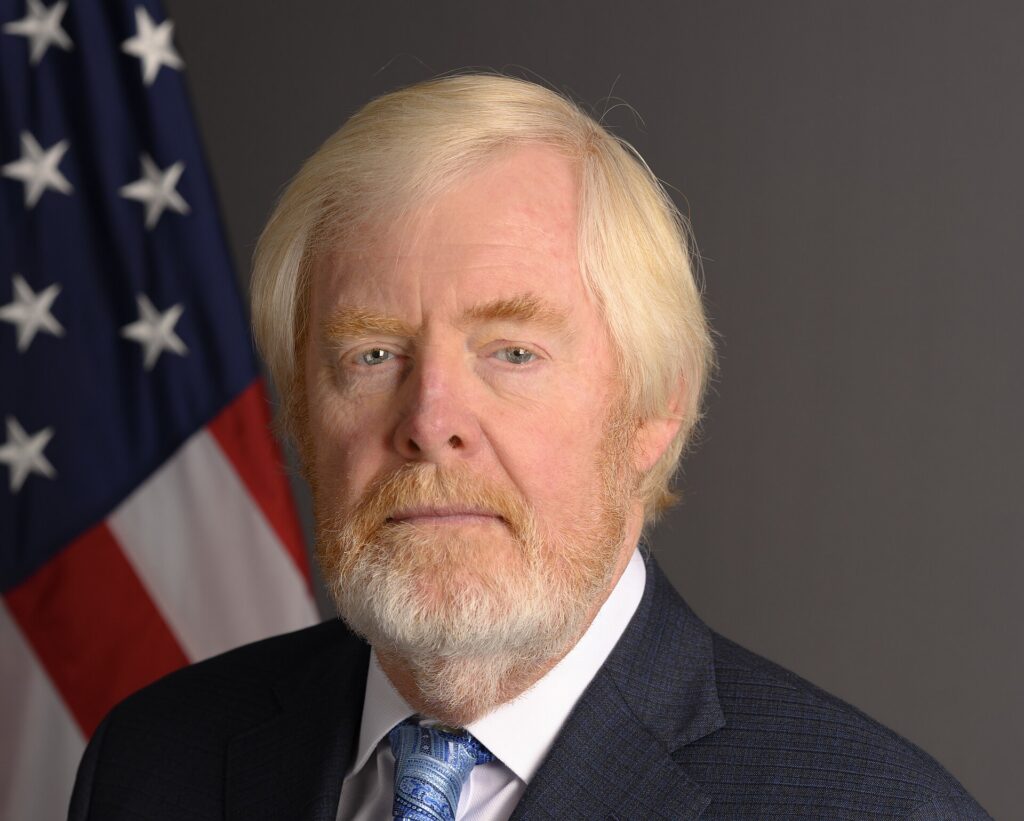
Leo Brent Bozell III, the newly appointed U.S. ambassador to South Africa has been pursuing both sides of the Trump administration agenda: promoting trade, while echoing the president’s criticisms of South African race relations. On March 11, after announcing a major new American investment initiative in South Africa, the ambassador also received a demarche order – a formal diplomatic protest by the South African government – over his comments criticizing affirmative action-style policies and land management in the country. The combination of U.S. economic incentives and tariffs, alongside strident criticism of South African domestic politics, has characterized rising tensions between the two countries.
Bozell, who arrived in Pretoria in late February, took up his post in the midst of a period of extremely tense relations between the two countries. The U.S. boycott of the South African-hosted G-20 summit last year, along with the new U.S. Afrikaner refugee program after U.S. allegations of land expropriation and “white genocide” in South Africa, and cuts to U.S. funding for aid programs, caused bilateral frictions. The U.S. decision to expel the South African ambassador to the United States, and the South African case in the International Court of Justice that implicates the U.S. in what they alleged was a genocide against Palestinians in Gaza, added to the conflict.
The controversial appointment of Bozell, a long-time conservative activist, is unlikely to quell these tensions. But some in South Africa hope the appointment of a new ambassador will at least bring stability in diplomatic relations between the two countries.
Who is Leo Brett Bozell III?
Bozell is an outspoken conservative and long-time Trump ally. His appointment as ambassador is his first diplomatic posting. Bozell comes from a well-networked conservative lineage, as the nephew of National Review Editor William F. Buckley, and son of anti-abortion activist L. Brent Bozell Jr. His son was sentenced for his active role in the Jan. 6, 2021, storming of the U.S. Capitol. Bozell started his political career in the now-defunct National Conservative Political Action Committee, and went on to found the Media Research Center, which sought to identify liberal bias in mass media.
Bozell is a particularly controversial choice to many in South Africa because of his recorded support for apartheid in the 1980s. A student activist at the time, he labeled the African National Congress – South Africa’s current ruling party, and a major organization in the anti-apartheid struggle – as a terrorist organization. He doubled down on these statements in social media posts in 2013 after the passing of former South African President Nelson Mandela, and complained that the media had “mythologized” South Africa’s founding father.
Bozell is one of several controversial nominees for ambassadorships by the Trump administration, and only the second in sub-Saharan Africa appointed thus far by the Trump administration. This ambassadorial post had been vacant since Trump’s inauguration, along with 34 other ambassadorships in the region. In Trump’s second term, non-diplomats who are loyal to the president have been selected for the vast majority of ambassadorships, bypassing senior Foreign Service officers. This approach is at odds with long-time international diplomacy practices, and has attracted substantial criticism. An article in The Atlantic, for example, noted a series of recent diplomatic missteps at the ambassadorial level and questioned whether some of the Trump appointees “seem to think that their job is to carry their boss’s boorishness and petty grievances abroad.”
Bozell’s views mirror administration priorities
In early 2025, Bozell was announced (and later withdrawn) as a nominee to head the US Agency for Global Media. He was then nominated in March 2025 to serve as the U.S. ambassador to South Africa, and confirmed by the U.S. Senate in December.
In testimony before the Senate Foreign Relations committee, Bozell demurred on answering questions about the allegations of “white genocide.” His prepared statement outlined his priorities for U.S.-South Africa relations during his tenure, including “objections to South Africa’s geostrategic drift” in maintaining friendly diplomatic and trade ties with Russia, China, and Iran. He also expressed support for the Afrikaner refugee program, and a desire to promote fair trade between the countries.
Encouraging trade between the U.S. and South Africa is a priority for both countries, especially in the wake of the Trump administration tariffs and the limited renewal of the African Growth and Opportunity Act, U.S. legislation from 2020 that outlined tariff-free exports to the United States for many products from South Africa and other African countries. But Bozell’s refusal to debunk the U.S. allegations of “white genocide,” which experts and South African officials have repeatedly dismissed as misinformation, puts Bozell at odds with his host government. His support for the Afrikaner refugee program is also a point of contention, not only because it is based on false narratives of white precarity, but because the program is enormously unpopular with South Africans in general.
What’s next for U.S.-South Africa relations?
South African groups have reacted to Bozell’s arrival in South Africa’s capital with some concern. The conservative-leaning FW De Klerk Foundation has urged Bozell to rely on “fact-based” diplomacy, while some political parties on the left have already dismissed the appointment as an “act of aggression.” For his part, Bozell made a statement upon his arrival in South Africa, and said that he looked forward to working with South Africa “…where cooperation can unlock tremendous growth and stability and expanded opportunity. We will work constructively where our interests align and where our common values, freedom, fairness and the rule of law light the path ahead.”
With the planned scaling up of the Afrikaner refugee program and stalled U.S.-South Africa trade relations in the wake of the implementation of wide-ranging tariffs, South Africa’s President Cyril Ramaphosa has been seeking to strengthen ties with China and India, within the larger BRICS alliance. The Trump administration is likely to see these moves as counter to U.S. interests in the region, which will drive further tensions between the two countries.
At the same time, a recent Trump administration push to secure trade deals for mining rights to critical minerals across the African continent could position Bozell as a regional negotiator. The Trump administration has no confirmed ambassadors for many African countries, including Nigeria, Angola, the Democratic Republic of Congo, or Kenya.
Tensions between the U.S. and South Africa are unlikely to dissipate in the near term. In his first days on the job, the new U.S. ambassador focused on strategic incentives for partnership but also echoed Trump’s South Africa’s domestic politics. Whether these economic partnerships will set the tone between Washington and Pretoria, or whether the relationship will be hindered by the Trump administration’s focus on the debunked “white genocide” claims, remains to be seen.
Stay up to date on all things politics and political science. Bookmark our landing page and sign up for Good Authority’s weekly newsletter by entering your email address in the box below.