






Immigration and Customs Enforcement’s (ICE) budget is set to skyrocket. The One Big Beautiful Bill will triple ICE’s annual budget, making it the largest law enforcement agency in the country.
But the “unprecedented infusion of cash” into immigration enforcement is taking place amidst Americans’ growing opposition to deportations in general and to ICE in particular.
ICE’s popularity is falling
ICE was relatively popular at the start of Trump’s second term in office. The agency’s net favorability rating (favorable minus unfavorable), for instance, was +15 in a February 2-4, 2025, YouGov-Economist survey.
That +15 net rating, however, has declined sharply since then. So much so that ICE’s favorability rating was 13 points underwater (39% favorable vs 52% unfavorable) in a late-June poll by YouGov-Yahoo! And Quinnipiac University’s June 22-24, 2025, survey similarly showed that 56% of registered voters (and 64% of independents) disapproved of how ICE is doing its job.
There’s even rising public support for abolishing the agency altogether. Take this chart, for example.
Americans are increasingly opposed to ICE
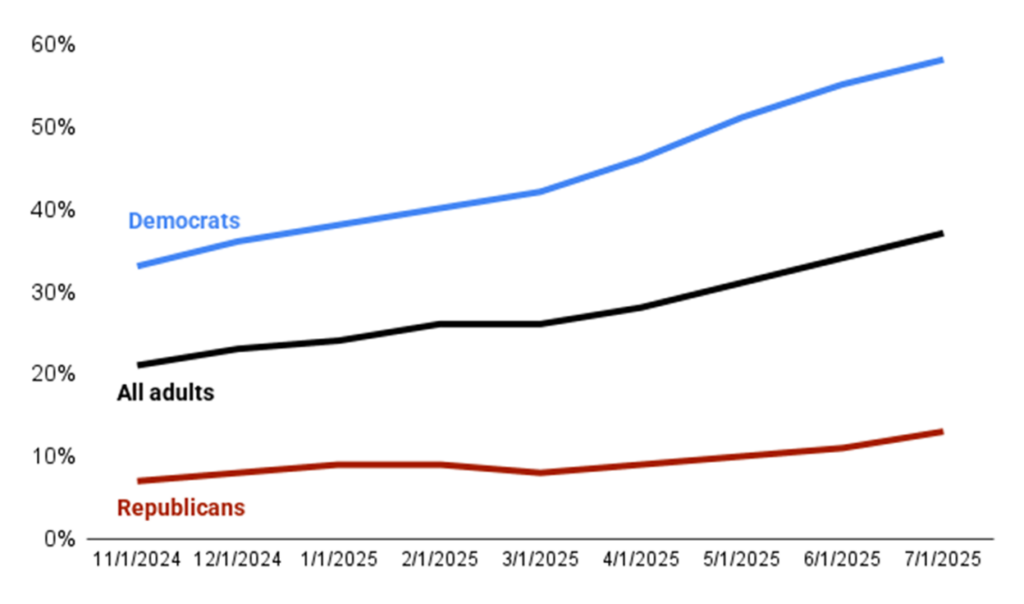
This chart shows that the share of registered voters in Civiqs’ Daily Tracking Poll who support abolishing ICE increased from 21% on Election Day 2024 to 37% at the start of July 2025. These figures are roughly in line with the percentage of adults who rated ICE “very unfavorably” in the above-mentioned YouGov polls from early February and late June (19% to 40%, respectively).
You can further see that Democrats are disproportionately driving the trend. Among Democrats, support for abolishing ICE grew from 33% in early November 2024 to 58% in July 2025. But the share of independents who are in favor of abolishing ICE also increased from 21% to 36% over the past nine months. And there’s even a six-point uptick in Republican support for abolishing ICE since the election.
ICE’s declining popularity is part of a broader trend
This growing opposition to ICE is consistent with broader trends in immigration attitudes over the past decade. In a 2024 report for the Democracy Fund, John Sides, Robert Griffin, and I showed how the public’s shifting immigration attitudes from 2016 through 2024 largely followed the changing discourse over the issue during the Trump and Biden presidencies. As politicians and the media shifted from criticizing unpopular Trump-era policies like family separation to expressing concern about the record number of border crossings during the Biden administration, the opinions of average Americans shifted in a similar way.
I noted back in April that these dramatic swings in immigration attitudes during the Trump and Biden presidencies dovetail with one influential account of public opinion: the thermostatic model of policy attitudes. In the thermostatic model, the public’s policy attitudes shift against the current president’s policies in response to real or perceived changes in the status quo – just like a thermostat will cool down a house when it gets too hot, or heat it up when it gets too cold.
The public is pushing back
With the two parties pushing different immigration policies even more than in the past, the public appears to be strongly pushing back. We, therefore, concluded our 2024 report by anticipating that future trends in immigration attitudes will be characterized by “an ebb and flow in public opinion that depends on the party of the president, the direction of policymaking, and the messages citizens receive from political leaders.”
That’s exactly what’s happening now. The immigration discourse over the past few months, of course, has increasingly moved away from its Biden-era focus on border security to outrage over ICE’s sweeping raids, wrongful detentions, deportations of “deserving” immigrants, and lawless behavior. Even Joe Rogan, a popular “manosphere” podcaster who supported Trump in 2024, has repeatedly described ICE raids on migrant workers as “insane” and “fucking nuts.”
It’s no surprise, then, that recent polling shows growing support for giving most undocumented immigrants in the United States a pathway to legal status – and rising disapproval of how Trump is handling deportations. Nor is it surprising that the ICE’s popularity is plummeting. After all, most Americans believe ICE’s actions have “gone too far,” according to the polls. Public opinion is simply shifting against the administration’s overreach on immigration in a thermostatic direction that was entirely foreseeable.
Stay up to date on all things politics and political science. Bookmark our landing page and sign up for Good Authority’s weekly newsletter by entering your email address in the box below.