






Recently, there have been allegations that TikTok has censored content on the platform after the Jan. 22 restructuring that shifted TikTok to a U.S.-based joint venture. More specifically, people alleged that certain types of content were no longer being accepted for posting on the platform or were receiving less engagement.
We conducted an over-time analysis of posts with particular keywords on TikTok before and after the restructuring. We do not find evidence consistent with these allegations. Although there was a dramatic decrease in volume for posts containing political- and non-political keywords alike, the patterns in our data are consistent with TikTok’s explanation of a broad Jan. 25 outage.
At the same time, we cannot definitively reject the possibility that the new owners changed TikTok’s core recommender system, and there are some important limitations to our analysis.
The ownership restructuring
On Jan. 22, 2026, TikTok announced that a deal had been reached to transfer majority ownership of U.S. TikTok to U.S. investors – the culmination of a yearslong attempt under both the Trump and Biden administrations to remove China’s data access and control over recommendations within the United States.
Since then, many TikTok creators and users have reported a variety of perceived distortions to TikTok, including the ostensible suppression of political videos and apparently blocked the keyword “epstein” due to content flag within private chats. TikTok has denied any change has taken place, but an accumulation of anecdotal evidence prompted many to decry that TikTok within the U.S. is being censored by a new body of opaque stakeholders.
There are three main allegations. First, users claim they couldn’t post anti-Trump content or that such content is not receiving views, including content critical of ICE activity in Minnesota. Second, some claim that TikTok intentionally suppressed content following the shooting of Minneapolis protester Alex Pretti. Third, some users say that dramatically less political content was being recommended on the For You feed.
We investigated each of these claims in turn. However, we only address whether the term “epstein” in TikTok posts was blocked in public posts, as we lack access to users’ private chats.
Barriers to posting content?
Several TikTok users reported being unable to mention the word “Epstein,” and being unable to upload content that was critical of ICE and President Trump. Many point to TikTok’s new ownership (often mentioning tech billionaire Larry Ellison’s ties to Trump), suggesting that the new owners are changing the site to curry favor with the Trump administration.
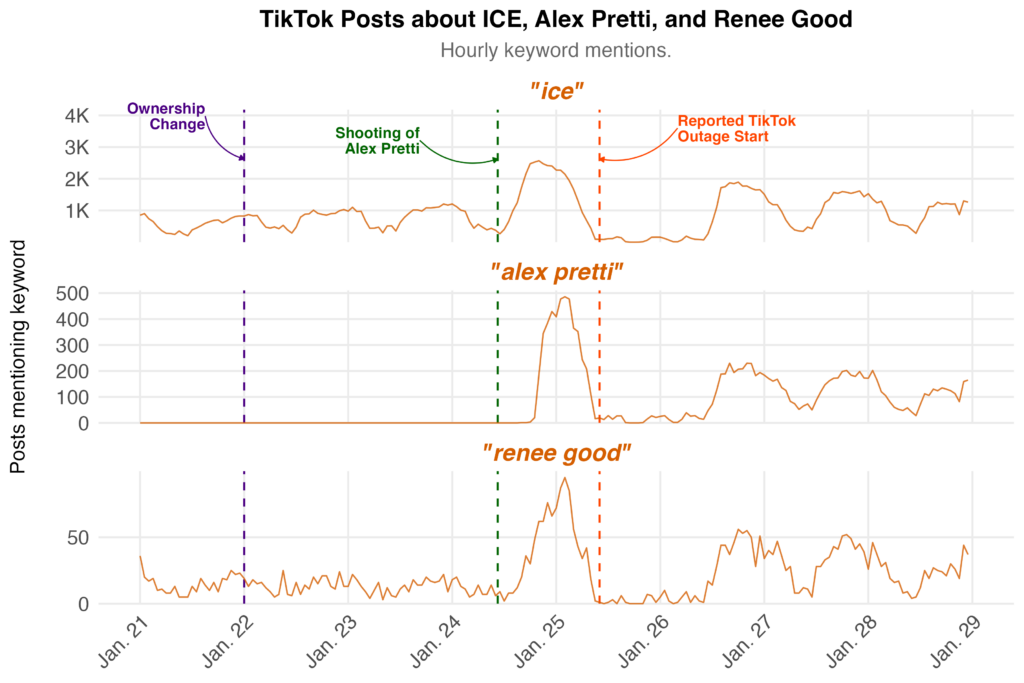
To investigate these claims, we track public TikToks containing relevant keywords (ICE, Alex Pretti, or Renee Good) in either the video description or metadata. There does not appear to be any large-scale prevention of content about these topics after the ownership change (the dotted purple line in the figure below). Mentions of all three keywords did drop in the morning of Jan. 25, coinciding with the reported TikTok outage (the dotted orange line), only to recover 24 hours later.
Was the inability to post on Jan. 25 limited to topics about the Pretti and Good shootings? On the contrary, content for all topics dropped off, suggesting that the outage was the more likely culprit. In the figure below, we look at a longer time period (Jan. 1 to Jan. 29) and compare the trends for the keywords “ice,” “alex pretti,” and “renee good” (shown in orange) with other political topics like “trump” and “epstein” (blue) as well as non-political issues such as “recipe” and “oscar” (green). Posts about all of these topics dropped to almost zero on Jan. 25, which again lines up with the reports of a TikTok outage on Jan. 25 at 4 am ET, marked with an orange dotted line.

TikTok claims that there was a U.S. server outage, and it’s worth noting that other technology companies experienced server outages from Jan. 23-25. Furthermore, power outages due to a historic winter storm were reported across the mid-Atlantic and the South from Jan. 24-26, which aligns with the outage timing. According to tech news site Tom’s Guide, “three of [Oracle’s] data centers are located in Ashburn, VA, smack dab in the middle of the massive winter storm Fern affecting much of the eastern and southeastern portions of the United States.” And power outages frequently cause problems with server hardware.
Lack of political content on the For You feed?
Some users reported seeing significantly less political content on their “For You” pages immediately after the TikTok deal. We cannot directly test this using data we’ve collected about videos posted on TikTok. (If readers would like to donate their individual TikTok data to our lab, contact us with the subject heading: TikTok Donation for Accountability. If we get enough submissions, we’ll follow up with another post!).
However, we can see how frequently TikTok recommended videos in the aggregate using viewership metrics. The figure below shows the total views of videos over time, for both political and non-political keywords:
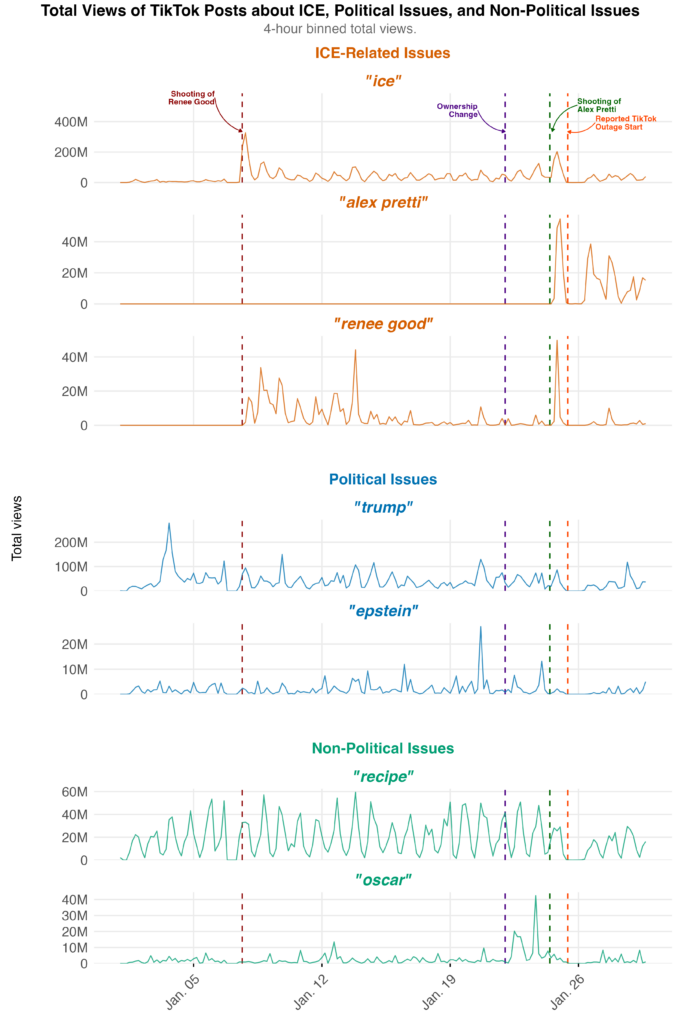
The same pattern is visible: Total views plummeted directly after the TikTok outage, and then began to rebound.
Caveats to keep in mind
While we don’t find evidence of widespread suppression of political content, we can’t rule out more subtle forms of content moderation. First, it could be that small numbers of posts were removed or shadowbanned in a way that is not visible in the overall trends. Relatedly, we cannot rule out that certain types of posts (such as anti-Trump posts) containing keywords like ICE or Epstein were prohibited or shadowbanned. Still, this would have to have been rare enough to leave the overall trendlines intact, unless there was a simultaneous effort to add other types of posts (such as pro-Trump posts) that would be picked up by our keyword searches. Third, we can only observe what has happened with public posts; it is possible that something different could have been happening with private posts. Finally, our analysis is limited by the specific keywords we selected, and we cannot rule out censorship affecting other keywords or topics.
Part of the challenge is that the data that TikTok makes available is insufficient to perform more nuanced analyses of its recommender system and content moderation practices. Our position is that TikTok and other platforms should provide a way for third-party researchers to study their recommender systems and look for evidence of undue political influence.
What this all means
Of course, none of our findings say that TikTok has not changed under its new ownership, nor that it won’t in the future. However, we have yet to see systematic evidence of such changes.
And although policymakers and the public need to know what is happening on these platforms, making accusations based on a few anecdotes is counterproductive and may even make the platforms less susceptible to public pressure. That’s because false accusations may reduce the cost of actually committing an unethical act. Call it the “Suspect’s Dividend” (the inverse of the “Liar’s Dividend”): If a company is going to be accused of currying favor with the administration even when it’s not, then it may make sense to reap the benefits of doing so, given that people aren’t going to believe that the platforms would behave ethically.
We are also once again reminded of the cardinal rule of social media analysis: Social media platforms are incredibly popular, which means we can find examples of many things on any given day. Assessing whether particular anecdotal examples are systematic of broader patterns on the platform, however, remains a different question.
Declarations: None of the authors have worked for TikTok, received any funding from TikTok, nor have a significant financial interest in TikTok.
Benjamin Guinaudeau is assistant professor at Université Laval in Québec and faculty research affiliate at Center for Social Media, AI, and Politics (CSMAP) at New York University.
Kylan Rutherford is postdoctoral fellow at NYU’s Center for Social Media, AI, and Politics (CSMAP).
Solomon Messing is a research associate professor at NYU’s Center for Social Media, AI, and Politics (CSMAP).
Margaret E. Roberts is the Chancellor’s Associates Endowed Chair Professor of Political Science at UC San Diego and co-director of the China Data Lab at the 21st Century China Center.
Andreu Casas is an associate professor in political communication at Royal Holloway University of London, and the director of the London Social Media Observatory.
Keng-Chi Chang is an assistant professor in quantitative social science at Dartmouth College and a nonresident scholar at the 21st Century China Center at UC San Diego.
Hennes Barnehl is a PhD student in political science at the University of California, San Diego.
Joshua A. Tucker is Julius Silver Professor, professor of politics, director of the Jordan Center for the Advanced Study of Russia, and co-director of the Center for Social Media, AI, and Politics (CSMAP) at New York University.