





The Netherlands has just held one of the tightest elections in recent memory. With nearly all domestic votes counted, the center-left Liberal Democrats (D66) under the young and charismatic Rob Jetten lead the far-right Party for Freedom (PVV) – led by Geert Wilders – by about 15,000 votes. While the final results won’t be available until early next week, here are three quick takeaways about the election, and what comes next.
A reshuffling rather than a shift to the center
Several major newspapers are reporting this election as a setback for the far right, and a victory for the political center. For example, the New York Times called the result “a major win for the political center and a big defeat for the far-right party of Geert Wilders.” The Washington Post proclaimed the election delivered a “rebuke to the far right.”

This framing oversimplifies what is more a reshuffling within ideological blocs, rather than a dramatic shift between them. As the figure above shows, the PVV’s losses were absorbed primarily by gains for two other far-right parties, JA21 and Forum for Democracy (FvD). I also counted the BBB as a far-right party, which is more controversial but it doesn’t change the main insights much. Dutch voters remain highly volatile in their party loyalties. Yet, the overall ideological leanings in the electorate are relatively stable.
The PVV became the largest party after surprising gains in 2023. The PVV was able to form a coalition government with other right-wing parties but these parties did not want Wilders as the prime minister. Instead, the government was led by Dick Schoof, a civil servant without party affiliation. Eleven months into the new government Wilders withdrew his party, claiming his coalition partners were not willing to curtail immigration. He also did this in 2012, which was the last time his party supported a coalition government. As a consequence, party leaders representing two-thirds of the newly elected parliament have vowed not to govern with Wilders. JA21 explicitly campaigned as a more reasonable potential coalition partner for a right-wing government, which may explain why they were able to peel off PVV voters.
On the center right, the New Social Contract (NSC) collapsed after its charismatic leader Pieter Omtzigt exited politics, sending many of its voters to the Christian Democrats (CDA) and D66. On the center left, D66 gained ground partly at the expense of the GreenLeft–Labour alliance, whose veteran leader Frans Timmermans resigned after a disappointing showing.
Dutch voters remain highly volatile in their party loyalties. Yet, the overall ideological leanings in the electorate are relatively stable.
Leadership matters
D66 and PVV seem likely to end up with the same number of seats. Yet who wins the actual vote count still matters. The largest party traditionally gets the first opportunity to explore a coalition to form the next government. Since both the center left and center right have said they will not govern with Wilders, a path that includes the PVV looks blocked. That means that Jetten will likely eventually get the chance to form a coalition and become the country’s next prime minister.
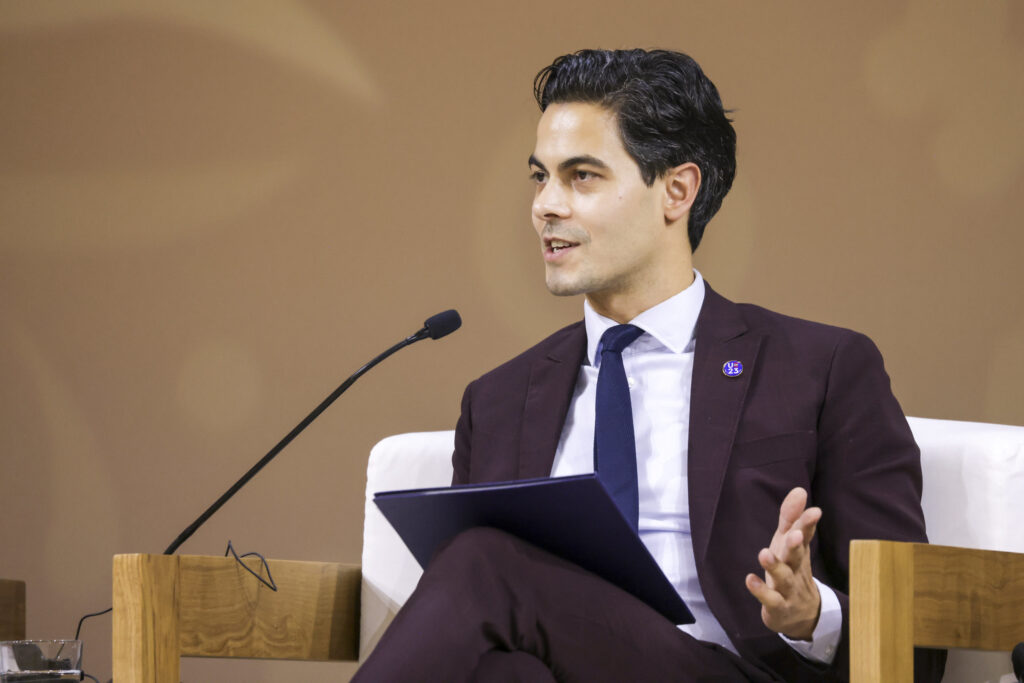
Still, the symbolism of finishing first carries political weight. Many in the Netherlands admire Jetten for the campaign he has run. He is charismatic, good looking, competent, and relatively young – just 38. He is open about his personal life: He is gay and engaged to an Argentinian Olympic field hockey player. Jetten ran a largely positive campaign that was both nationalistic and pro-European, with both E.U. and Dutch flags prominently on display during campaign events. Early surveys suggest that his campaign style lifted D66, the perennial also-rans, to its best-ever election result.
We will likely see a centrist coalition, although it will not be easy
Jetten will need all his leadership qualities and charisma to successfully form a government. This election underscores just how fragmented the Dutch political landscape has become. The 150 seats are divided among 15 parties, including single-issue parties, like the elderly party (50plus) and the party for the animals (PvdD). The largest party in the new parliament will now hold only 26 seats, the lowest share ever recorded (the previous low was 31).
Any governing majority would require at least four parties. The Dutch are generally reluctant to form minority governments, and the most plausible minority option – linking D66, CDA, and the GreenLeft–Labour alliance – would face a steep uphill battle, especially given its weakness in the Senate. A center-right coalition of D66, VVD, CDA, BBB, and JA21 is possible but Jetten won’t want to rule a coalition with all members to his right.
The most viable outcome is a grand coalition bridging left and right. This would not be an easy partnership: The VVD and GreenLeft–Labour do not want to govern together, each accusing the other of having become too extreme. The VVD has even explicitly committed not to step into a coalition with the left.
There are few credible alternatives. Recent history has seen the Netherlands oscillate between broad centrist coalitions and coalitions that include the far right. The VVD will worry that joining a center-left leaning coalition will make it vulnerable in the next election. Yet, being in opposition alongside the much louder PVV also carries risks for the VVD as the party has based its electoral support on being the responsible right-wing party.
Everyone expects long and difficult coalition negotiations before the Netherlands sees its next government. Jetten may find a creative solution but the most likely outcome seems a centrist coalition – with strong opposition from the far right, led by Wilders. Perhaps the threat of another swing towards the PVV may help keep that coalition together, at least for a little while.