





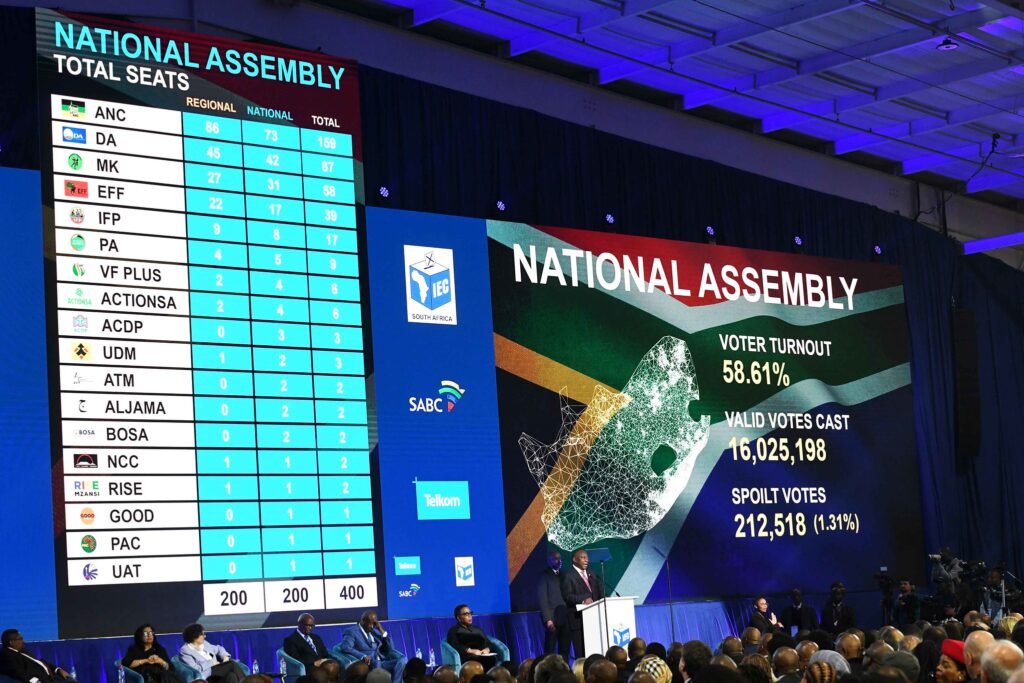
South Africa’s May 29, 2024, elections mark a pivotal moment in the country’s democratic history. For the first time, the African National Congress (ANC) failed to secure a majority in the National Assembly, the country’s lower house. The elections, run by the well-respected Independent Electoral Commission (IEC), were once more free and fair.
Electoral support for the ANC peaked at 70% in 2004, but has steadily declined since then. This year the party lost a full 17 percentage points from its 2019 elections vote share. This significant loss has humbled the party that Nelson Mandela once led to victory in the nation’s first fully democratic elections in 1994.
Everything has changed
So strong has the ANC’s support been since that first election that, despite this 17-point decline, the party still won a strong plurality of the vote – just over 40%. This is close to twice the vote share of the nearest opponent, the Democratic Alliance (DA), which claimed nearly 22% of the vote. One big surprise, however, was the rise of the six-month-old uMkhonto weSizwe (MK) party. MK, the party of former president Jacob Zuma, captured 14.5% of the vote and displaced the Economic Freedom Fighters (EFF) as the country’s third-largest party.
The election was not short of drama. Technical problems at many polling stations, combined with budget cuts over the last few years, meant that tens of thousands of South Africans faced extremely long lines – some only cast their vote in the early hours of May 30. Election officials completed the vote count swiftly and with few issues. But the leadership of the new MK party demanded the IEC not ratify the results and instead hold a “revote.”
Despite this eerie parallel to the U.S. 2020 post-election upheavals, South Africa’s institutions have held fast. The IEC ratified the results as planned on June 2 at a public ceremony attended by both incumbent President Cyril Ramaphosa and Chief Justice Raymond Zondo. Ramaphosa delivered an admirable “concession” speech, reaffirming the ANC’s commitment to the constitution, the rule of law, and the choice of the people.
What’s next for the ANC?
Ramaphosa now faces a stern test of his statesmanship. Can he maintain his hold on the ANC even as members of his party question his leadership, while also steering South Africa through a period of profound political change?
His first challenge will be to find enough votes in parliament to secure another presidential term. Under South Africa’s parliamentary electoral system, the country will now be governed by either a minority government or a true coalition government for the first time. There is no doubt that elite and parliamentary politics in South Africa is about to change dramatically.
Either route presents the ANC with new challenges, including the composition of the cabinet and the priorities the new government will pursue. There will likely also be implications for oversight and accountability, a desperately important theme in a country wracked with grand corruption – or as South Africans have come to refer to it, “state capture.”
Beyond the implications for the executive, the nature of legislation will have to change. The ANC has for 30 years been free to legislate in whatever fashion it likes. South Africa’s most decisive politics thus took place either behind closed doors at Luthuli House, the ANC headquarters – or at the ANC’s quinquennial conferences to decide on the party’s leadership and major policy directions.
Without an ANC majority in parliament, the very nature of the act of legislation in South Africa’s parliament must change. The crux is this: South Africa has finally entered a period of inter-party rather than intra-party political competition.
But nothing is different
While South Africa has surely entered a new period in its political history, strikingly little has really changed in the country’s underlying electoral politics. Leading up to the election, many expected to see voters decisively reject the ANC after decades of low growth, the world’s highest unemployment rate, high levels of violent crime, unstable electricity and water supply, and grand corruption. And that is the interpretation of the final results many commentators reported. The reality is quite different.
In the end, the lion’s share of the ANC’s lost vote didn’t go to the country’s long-standing opposition parties. The DA, the center-right opposition, gained just one percentage point at the polls, largely by winning back voters from a rightwing white party that had taken those votes in 2019 (the Freedom Front Plus). The EFF, the country’s radical left opposition, which emerged in the wake of the 2012 Marikana massacre, fared even worse by losing a percentage point.
Instead, the vast majority of the ANC’s lost votes moved wholesale to MK, a new party without much of a substantive manifesto. MK is the party of former ANC and South African president Jacob Zuma, who led the country from 2009 through 2017. Many South Africans refer to this period now as the “lost decade.”
This election was not a verdict against the ANC per se. The vast majority of the electorate voted for the same politicians and ideas as they did in 2019. The big change is that the parties to whom those politicians and ideas belong have now shifted. We’ve now witnessed an elite realignment, not a groundswell from a disgruntled electorate seeking change.
Low voter turnout
Most disturbing, perhaps, is the continued decline in voter turnout. Turnout among the registered population declined from 66% in 2019 to just 58% this year. This means that only 4 in 10 South Africans of voting age cast a ballot on election day. Some of that decline may be due to the long lines at the polls, which researchers have shown decrease day-of turnout. In South Africa much of the turnout decline is likely due to generational replacement challenges. Younger voters, who are deeply disengaged from formal electoral politics, are slow to replace older voters, most of whom are registered and tend to vote at high rates.
The electoral politics of South Africa appear bleak. The younger generation seems to have opted out of formal politics. And a dwindling older core of voters has essentially voted, once more, for more of the same.
What does the future hold?
As the dust settles, a few points are worth dwelling on. One is the visible rise in electoral support for openly ethno-nationalist parties. The rising MK party is evidently rooted in a resurgent Zulu ethnic nationalism. And the election saw the parallel rise of the Patriotic Alliance (PA) and National Coloured Congress (NCC) in the Western Cape, both of which made identity appeals focused on South Africa’s Coloured community central to their campaigns.
Some commentators see this as a concerning shift in the political landscape. Yet the rise of such parties is visible only because of the split in the ANC: The very same forces of populist Zulu nationalism helped sustain the ANC’s hold on South African politics after Jacob Zuma won the ANC presidency in 2007. Indeed, Zuma’s ascendancy in 2007 relied in part on his popularity in rural KwaZulu-Natal, the country’s second-most populous province. This is where the party had historically faced strong competition from the Inkatha Freedom Party (IFP).
One might then see the rise of MK as Jacob Zuma taking back what he delivered. In 2009 the ANC gained almost a million votes in KwaZulu Natal from the IFP, mostly on the back of Zuma’s leadership. Likewise, the parallel rise of the PA and NCC, while certainly noteworthy, is marginal at best: All three parties together drew only 17% of the national vote in total. One silver lining for South Africa is that, for now at least, a large majority of South Africans have rejected populist ethno-nationalism.
Who will lead the next government?
The key question for the next few weeks is how the ANC will form a government, and who will lead that government as president. The national assembly has 400 seats in total. The ANC, with 159 seats, will need to find an additional 42 seats to meet the 201 seats needed to elect a president and form a government, pass bills, and maintain the confidence of parliament.
On June 6, Ramaphosa, speaking on behalf of the ANC’s National Executive Committee (NEC), announced the party’s intention to seek a government of national unity. This echoes the 1994 government in which ANC leader Nelson Mandela handed key cabinet positions to members of other parties. So far, the ANC has held discussions with multiple potential partners including the DA (87 seats), the EFF (39 seats), the IFP (17 seats), as well as other smaller parties. Notably, the ANC has seemingly not held discussions with MK, though the door remains open for those conversations to begin.
National unity – and stability
Though Ramaphosa outlined a number of ideological and procedural guiding principles, how exactly the envisaged government of national unity will work is unclear. One thing that is clear is that Ramaphosa will likely lead the government as president. Yet the internal politics and factionalism of the ANC are opaque, and it would not be a shock if he were displaced as negotiations continue.
Whoever leads the ANC will have to find a way to both form a stable government while also charting a meaningful political trajectory for the party. But entering into an agreement with the DA or the EFF would create new political risks for ANC. Some commentators, as well as senior ANC members, speculate that any coalition involving the DA would deeply undermine the ANC’s future electoral prospects. The DA remains a predominantly white party, and its preferred economic policies are reasonably far from the ANC’s center-left tradition.
Voters might see a close collaboration between the two parties as trading away the ANC’s identity, harming its status irreparably when the party is already badly wounded. While the EFF is perhaps ideologically closer to the ANC, that party holds relatively extreme positions on a number of critical policy questions, and would likely demand control of significant economic levers in exchange for its support.
The next days and week will reveal precisely how realistic a government of national unity is. It remains possible that the ANC will revert to a minority government, or some more contained coalition. Whatever happens, whether the incoming government can possibly bring transformative change to South Africa, or even survive in the medium run, remains to be seen.
Daniel De Kadt is an assistant professor of quantitative research methods at the London School of Economics and Political Science and the author of many articles on South African electoral politics.