






Yesterday, Representative Nancy Pelosi (D-Calif.) announced she would not seek reelection in 2026. For almost 40 years Pelosi has defined power in Congress – how to get it and how to wield it. Known for ruling with a “velvet glove,” Pelosi combined feminine touches like being attentive to members’ family milestones and offering Ghirardelli chocolates to visitors with a clear-eyed view of political combat. She even wrote a book entitled, Know Your Power, and another, The Art of Power.
Claiming her power
In 1987, when Pelosi was first elected to Congress, there were very few women members and women did not hold leadership positions. She gained a post on the prestigious House Appropriations Committee. Working with Nita Lowey (D-N.Y.) and Rosa DeLauro (D-Conn.), the three women members, nicknamed “DeLosi,” steered federal funds to women’s health and child welfare programs.
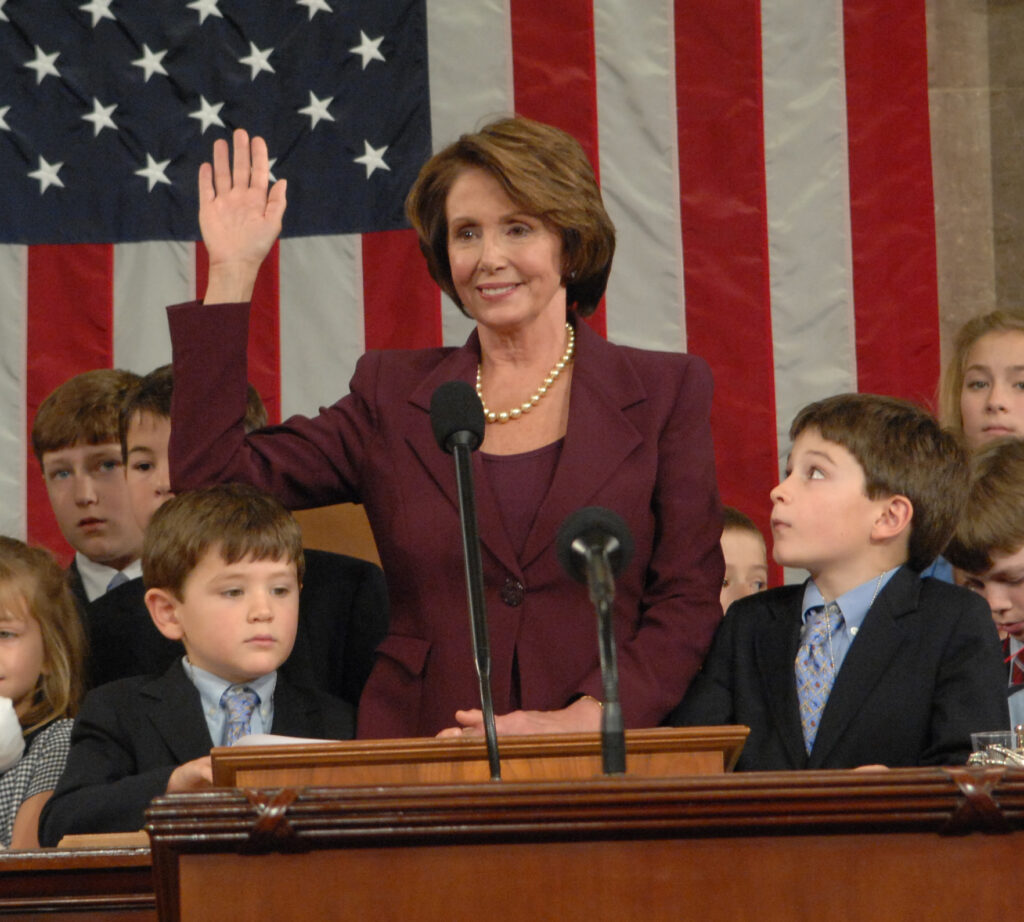
Throughout the 1990s, women in Congress never reached positions beyond the lowest rungs of party leadership, conference secretary, and vice-chair. Pelosi made her own luck and did not wait her turn. She declined to run for one of the lower-rung “women’s positions” and challenged Steny Hoyer (D-Md.) in 2001 to become the minority whip, when David Bonior (D-Mich.) retired. She quickly moved up to minority leader and on Jan. 3, 2007, she claimed the gavel as the first woman Speaker of the House, surrounded by the children and grandchildren of the members in the chamber.
The coalition builder
Pelosi’s strength came from her ability to build coalitions within her party. Propelled to leadership from a base of California liberals and female members, Pelosi immediately reached out to conservative Democrats by appointing John Spratt (D-S.C.), a Southern conservative, as assistant to the leader. She always touted her majority makers, the members from swing districts. Defying calls for her to step down and make way for new blood after Democrats reclaimed the majority in 2018, Pelosi neutralized her opposition by bringing them into leadership roles. For example, when Marcia Fudge (D-Ohio) suggested she might mount a bid for leader, Pelosi made Fudge chair of a subcommittee on voting rights – where she could pursue her civil rights agenda. Responding to complaints after the 2018 midterms that there were no women of color in leadership – after these voters mobilized to elevate Democrats to the majority – Pelosi expanded her leadership table. She created a new position for Barbara Lee (D-Calif.), who had lost a bid for conference chair to Hakeem Jefferies (D-N.Y.).
Pelosi used her power to legislate. She pressured President Barack Obama to make his signature health care legislation as expansive as possible. When anti-abortion Democrats threatened to sink the bill unless it included restrictions on abortion coverage in the health plans on the exchange, Pelosi confronted her abortion rights allies, pressuring them to accept the amendment and keep the bill moving.
Pelosi also was pivotal to the 2008 negotiations with the George W. Bush administration to move the Wall Street bailout through Congress, and help the American economy avoid collapse after the housing bubble burst. During the covid-19 pandemic, she moved stimulus plans by presidents Donald Trump and Joe Biden through Congress, and then helped Biden pass major climate and infrastructure legislation.
A partisan warrior for polarized times
While Pelosi excelled at backroom legislating, she epitomized the modern party leader, steering her partisan team with a focus on fundraising and message discipline. Maintaining a relentless travel schedule, she raised more than $1 billion for Democrats. Meanwhile, Republicans spent millions over the years characterizing her as a San Francisco liberal and touting her as the party’s lead bogeyman. She pushed back on that caricature by describing herself as a mother of five and grandmother guided by her strong Catholic faith. She often was more inclined to keep Democrats together in messaging and legislating than to reach across the aisle.
When President Trump came to power, Pelosi responded to him with confrontation. In February 2020, she famously ripped up a copy of Trump’s State of the Union Address during the speech because she said it contained too many lies.
In her most recent tangle with Trump – who calls her “Crazy Nancy” – Pelosi helped California pass a ballot initiative to allow her state to suspend its redistricting commission and create up to five new Democratic seats. The new map will blunt Republican efforts to create new GOP seats through mid-decade redistricting in Texas, North Carolina, and other states. If Pelosi’s efforts succeed in toppling the Republican majority in the 2026 midterm, she will help elevate Hakeem Jefferies to the speakership, making him the first Black Speaker of the House, and increasing Democratic influence even as she leaves the stage.
Michele L. Swers (@MicheleSwers) is a professor of American government at Georgetown University and author of Women in the Club: Gender and Policy Making in the Senate (University of Chicago Press, 2013), and co-author of Women and Politics: Paths to Power and Political Influence, Fifth Edition (Bloomsbury Publishing, 2025).
Stay up to date on all things politics and political science. Bookmark our landing page and sign up for Good Authority’s weekly newsletter by entering your email address in the box below.