





In a recent and much-discussed prime-time speech last week, President Biden took aim at “an extremism that threatens the very foundations of our republic.” According to Biden, these extremists “do not respect the Constitution,” “do not recognize the will of the people” and “refuse to accept the results of a free election.” The name he offered for the people who threaten U.S. democracy: MAGA Republicans.
But how do you identify MAGA Republicans? They are not an interest group, a political party or an organization with a membership list. Unless they are wearing the conspicuous red hat festooned with the words “Make America Great Again,” it’s difficult to know who identifies as MAGA and who are the traditional Republican adherents that Biden was “very clear, very clear” he did not associate with the MAGA Republicans’ rhetoric and actions.
As part of a larger project, we examined survey data from the South to answer that question, reasoning that the base of Republican strength in the United States lies in that region.
How we did our research
In August, the Center for Public Opinion and Policy Research at Winthrop University conducted an online poll of 2,256 adults in the 11 states of the old Confederacy. Respondents were drawn from a curated panel purchased from online survey company Marketing Systems Group and weighted by race, gender and age based on data from the U.S. Census Bureau to more closely match the population of those states. Participants were asked a variety of questions about politics and government.
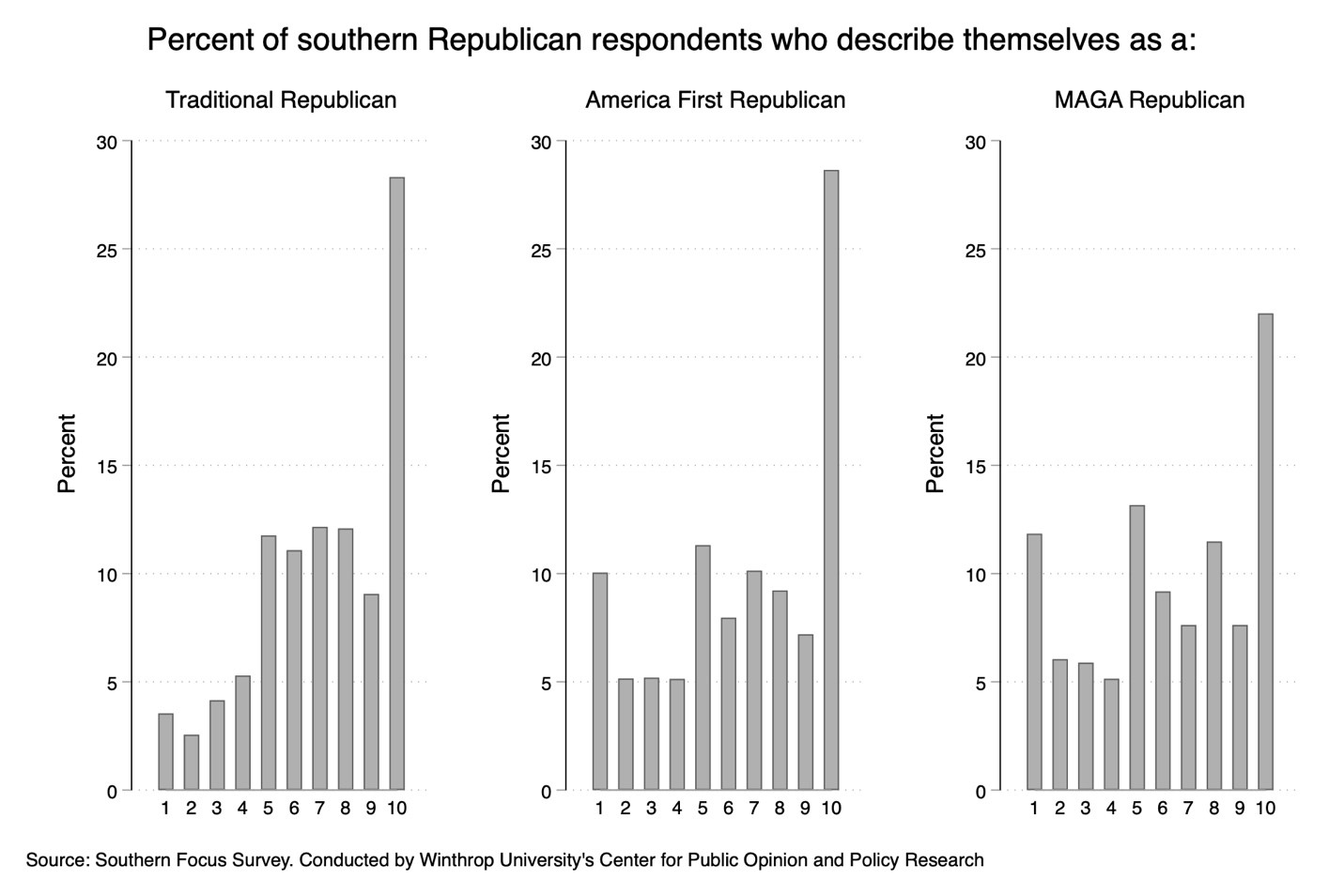
The 698 self-identified Republicans in the sample were asked to “tell us how well the following terms describe you, where 1 = not at all and 10 = completely describes me.” Participants were then provided with separate prompts for “MAGA Republican,” “America First Republican” and “Traditional Republican.” Independents who lean Republican did not receive those questions.
This wording allows for the possibility that an individual may have overlapping identities. Just because someone identifies more with the MAGA Republican label than the traditional Republican label does not mean they reject the traditional Republican description entirely. And, indeed, that is exactly what we find. Approximately 3 out of every 4 self-identified Republican respondents selected a six or higher for more than one Republican label.
Don’t miss any of TMC’s smart analysis! Sign up for our newsletter.
How many Southern Republicans identify as MAGA Republicans?
As you can see in the figure below, the strongest identification was with the “Traditional Republican” label, followed by “America First Republican.” The smallest proportion identified as MAGA Republicans, with just shy of a quarter of the Southern Republican respondents indicating a 10 for MAGA Republican. However, 58 percent ranked it a six or higher, suggesting that just over half of the Southern Republicans in our sample think the term MAGA Republican describes them more than it does not.
Altogether, this suggests that MAGA Republicans are a sizable proportion of the Southern Republican electorate, but not the dominant one.
What types of Southerners identify as MAGA Republicans?
Next, we examined which types of Southerners were most likely to identify with each of the three labels. Older Southerners were most likely to identify as “Traditional Republicans” or “America First Republicans”; age was unrelated to MAGA identification.
Self-identified males were more likely to describe themselves as MAGA Republicans or “America First Republicans,” whereas gender had no influence on the likelihood that someone would describe themselves as a “Traditional Republican.”
When we asked about political attitudes, we found that approximately 80 percent of the respondents who answered with 10 on the MAGA identification scale did not believe the results of the 2020 election were fair and accurate, compared with 75 percent who identified most strongly with “America First Republican” and 66 percent who had the strongest possible identification as “Traditional Republicans.” Not surprisingly, the strongest MAGA Republican identifiers (at 91 percent) are also more likely than most ardent “Traditional Republicans” or “America first Republican” identifiers (both 85 percent) to believe Donald Trump should not be charged with a crime for his involvement in the insurrection at the U.S. Capitol on Jan. 6, 2021.
Republican candidates are increasingly sharing misinformation, research finds.
The future of partisan identification
In his Sept. 1 speech, Biden differentiated between MAGA Republicans, who he argued are a threat to democracy, and “mainstream Republicans” who do not “embrace their extreme ideology.” Our findings suggest that these groups are not entirely distinct. Many Republicans in our sample believe all three terms — “Traditional Republican,” “MAGA Republican” and “America First Republican” — accurately describe them.
Nonetheless, MAGA Republican identifiers do stand apart. They are mostly men, less likely to believe that Trump should be prosecuted for the events of Jan. 6 and less likely to believe that the 2020 election was fair and accurate.
Political scientists have long argued that identifying with a particular party shapes how someone sees political events and helps structure their world views. Perhaps we should also consider the possibility that intraparty identification has a similar effect on important political attitudes. According to our data on Southern Republican affiliates, Biden was not off the mark in identifying MAGA Republicans as the main culprits in denying the legitimacy of the 2020 election. Further, because other Republican subgroups identify at least somewhat with their MAGA brethren, the MAGA faction may well have even more influence on the modern Republican Party than Biden suggested.
Christopher A. Cooper (@chriscooperwcu) is the Madison distinguished professor of political science and public affairs and director of Western Carolina University’s Public Policy Institute in Cullowhee, N.C., and co-author (with H. Gibbs Knotts) of “The Resilience of Southern Identity: Why the South Still Matters in the Minds of its People” (UNC Press, 2017).
Scott Huffmon (@HuffmonPolitics) is professor of political science and director of the Center for Public Opinion and Policy Research at Winthrop University in Rock Hill, S.C.
Gibbs Knotts (@GibbsKnotts) is professor of political science and dean of the School of Humanities and Social Sciences at the College of Charleston in Charleston, S.C., and co-author (with Jordan M. Ragusa) of “First in the South: Why South Carolina’s Presidential Primary Matters” (University of South Carolina Press, 2019).
Seth C. McKee is professor of political science at Oklahoma State University in Stillwater, Okla., and author, most recently, with M.V. Hood III, of “Rural Republican Realignment in the Modern South: the Untold Story” (University of South Carolina Press, 2022).