

Earlier this year, Gabon’s government suspended access to Facebook, WhatsApp, Instagram, and YouTube. Leaders claimed the move addressed “national security” concerns and stopped the spread of misinformation. But activists noted the timing coincided with anti-government protests and a labor strike.
Elsewhere in Africa, pressure on traditional media has also intensified. In Zimbabwe, journalist Blessed Mhlanga was arrested in February after criticizing media repression. Reporters and commentators who challenge government narratives have faced similar treatment in Burkina Faso, Cameroon, and Niger.
World Press Freedom Day on May 3 prompts us to think about the gap between official commitments to media freedom and the reality experienced by journalists on the ground. Governments across Africa have been restricting digital spaces, via social media bans and temporary internet shutdowns. And they’re also using direct pressure and intimidation to control what information is reported in traditional media.
A gap between ideals and experience
What do Africans think about the state of media freedom in their countries today? We examine data from nationally representative surveys collected in 38 countries by Afrobarometer, an independent, pan-African research network, which provides important analysis.
Africans’ support for media freedom is strong. In the surveys conducted from January 2024 to June 2025, almost two-thirds of those surveyed (65%) agreed with a statement that “the media should have the right to publish any views and ideas without government control.” Yet 32% said that “the government should have the right to prevent the media from publishing things that it disapproves of.”
Most Africans surveyed support the role of the media in holding governments accountable. Almost three-quarters (72%) agreed that “The news media should constantly investigate and report on government mistakes and corruption.” Only 26% say that “Too much reporting on negative events” is harmful.
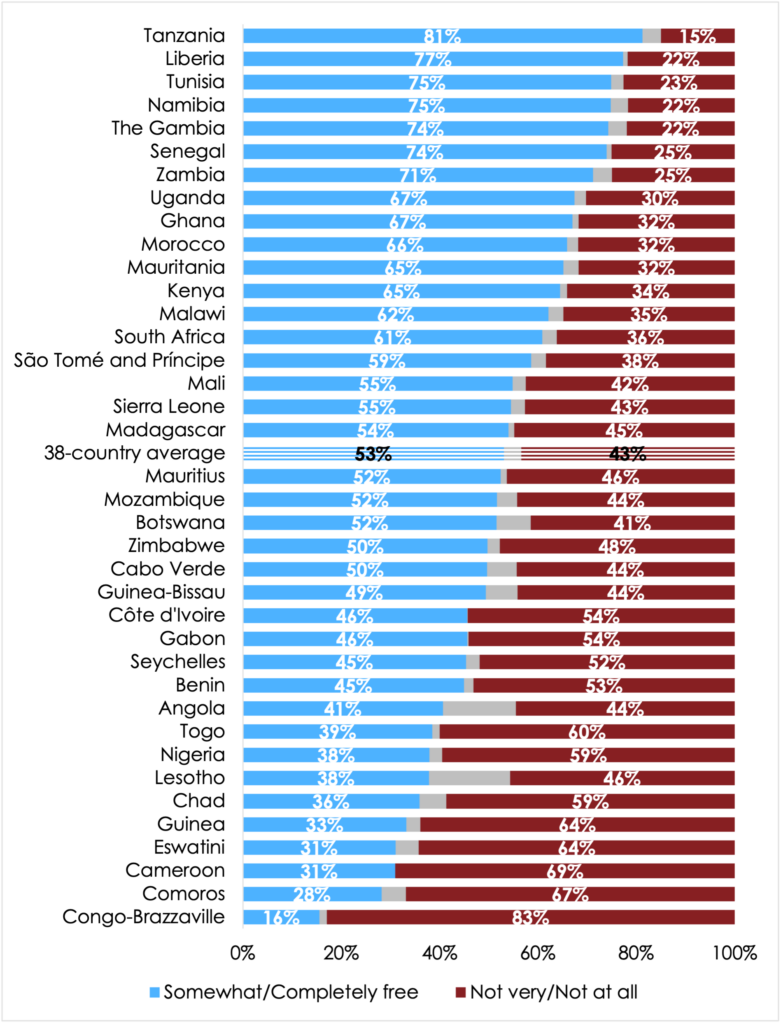
However, many Africans don’t think their government is protecting media freedoms. A slight majority (53%) say the media in their country are largely free. But 43% believe they are subject to censorship or government interference. Figure 1 below details how these findings vary widely by country, ranging from high levels of perceived media freedom in Tanzania (81%), Liberia (77%), and Tunisia (75%) to much lower levels in Cameroon (31%), Comoros (28%), and Congo-Brazzaville (16%).
Figure 1. Public perceptions of media freedom | 38 African countries | 2024 – 2025
Consider the experiences of Guinea and Mali
Public attitudes about the media typically depend on the local political situation. In Guinea, only 33% of those interviewed by Afrobarometer saw the media as free in 2024. This marked a large drop from the 67% who said the same in 2019.
After the military ousted Guinea’s elected government in 2021, nearly two dozen journalists have been detained or arrested, and multiple broadcasters have been shuttered. Habib Marouane Camara, a journalist with the private news site Le Révélateur 224, has been missing since December 2024, when he was violently abducted by men in gendarme uniforms. Despite these attacks, Guineans remain firmly supportive of press freedoms, with 66% opposing government controls.
Neighboring Mali presents a contrast. Like Guinea, Mali is also under military rule, and the media have faced similar attacks, including jailed journalists, suspended outlets, and bans on certain foreign publications. However, Malians seem to have largely accepted these moves, with 70% supporting government restrictions on the press (see Figure 2).
One explanation is that Malians may be prioritizing security concerns over a free and independent press. In recent decades, Mali has experienced communal violence, Islamist extremism, and human rights abuses by security forces, leaving thousands dead, over 750,000 internally displaced, and some 1.5 million people experiencing food insecurity. Military leaders have spent years accusing foreign and independent media of fomenting violence. And research on Mali and elsewhere has linked social media to spreading extremism and communal conflict. This may be making people more open to limits on media freedoms (see Figure 3).
Figure 2. Support for media freedom | 38 countries | 2024 – 2025
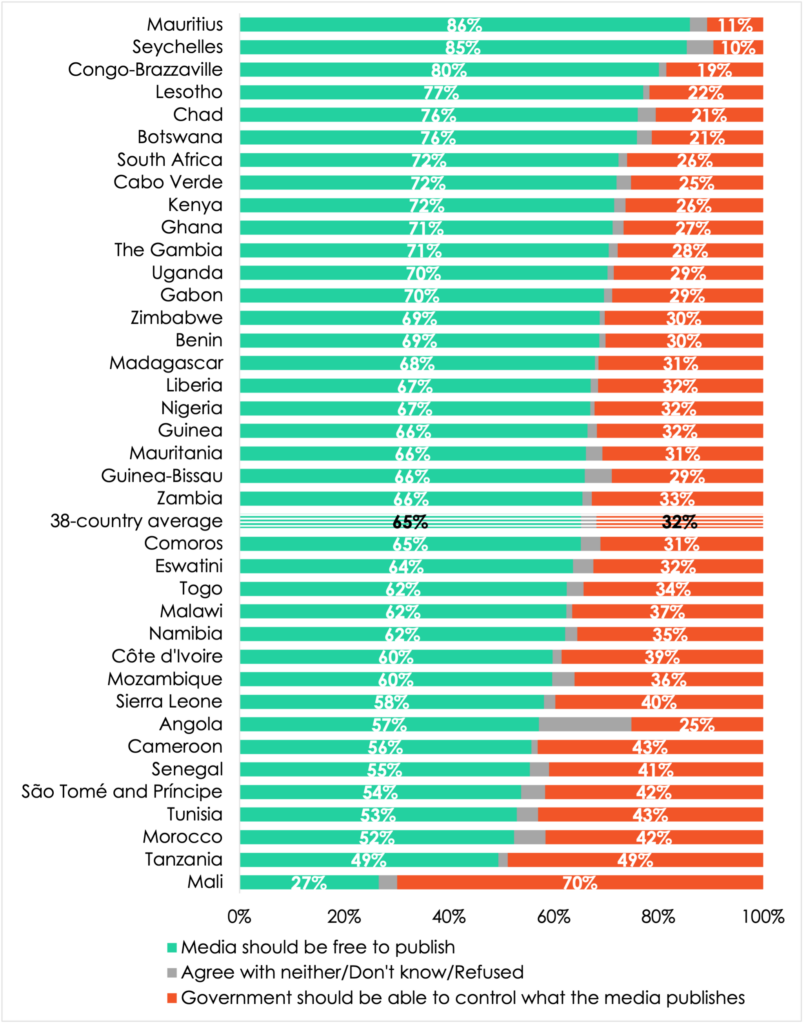
Statement 1: The media should have the right to publish any views and ideas without government
control.
Statement 2: The government should have the right to prevent the media from publishing things that it disapproves of.
Figure 3. Support for media oversight of government | 38 countries | 2024 – 2025
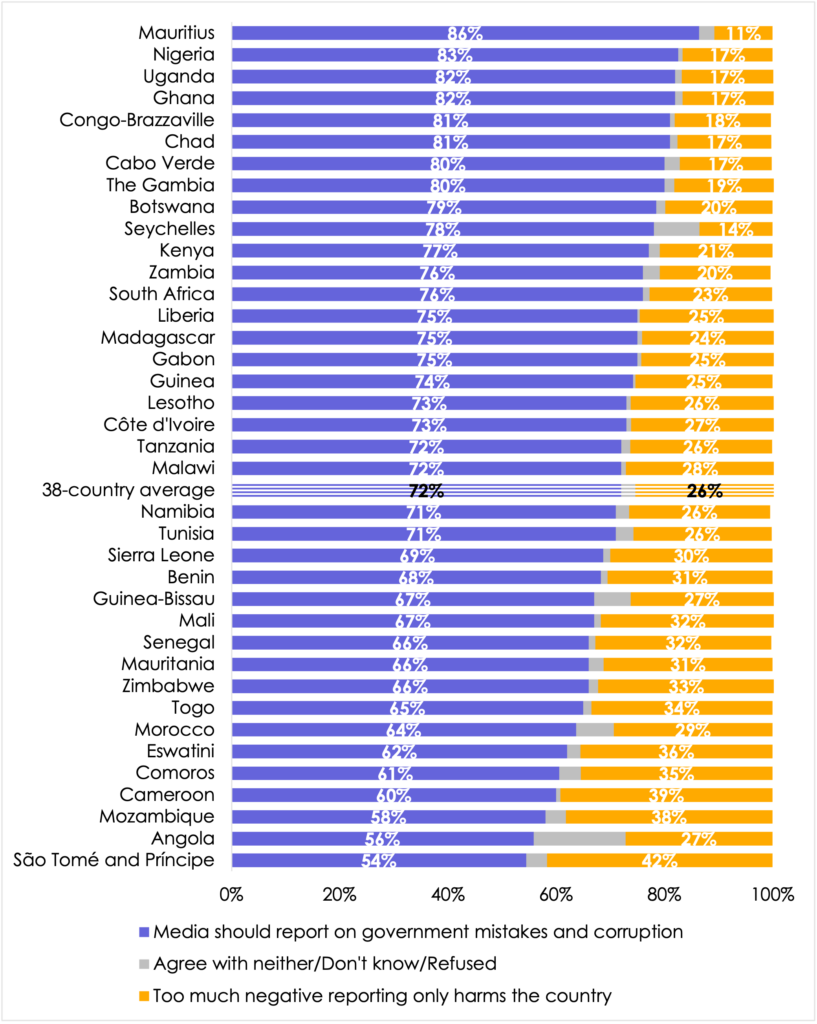
Statement 1: The news media should constantly investigate and report on government mistakes and corruption.
Statement 2: Too much reporting on negative events, like government mistakes and corruption, only harms the country.
Why public opinion matters
In countries like Guinea, many citizens perceive a gap between the independent media they want and what their governments are allowing. History shows that the public can push governments to reverse course on infringements to basic rights, but successful protest requires organization. The withdrawal of outside support for independent media might make opposing these moves harder.
However, cases like Mali raise a different kind of concern. Research shows that when governments can convince weary publics that liberal rights like press freedom undermine basic needs like security, governments gain more leeway in imposing limits. Independent media have the best chance of survival when citizens see these freedoms as democratic essentials, rather than as potential liabilities.
The purpose of World Press Freedom Day is to remind us that “press freedom and independent journalism are key to peace, economic recovery, sustainable development, and human rights.” For governments around the world, it’s a reminder to assess the state of press freedom and defend the media from attacks on their independence. Analysis of recent Afrobarometer survey data, however, underscores how public support for media freedom diverges from the everyday realities of restrictions on media activities.
Kelechi Amakoh is a PhD candidate in the Department of Political Science at Michigan State University and a 2025-2026 Good Authority fellow.
Komi Amewunou is an editor for Afrobarometer.
Jeffrey Conroy-Krutz is an associate professor at Michigan State University and editor of the Afrobarometer Working Papers series.